
Why in the News?
- Recently, Delhi government decided to declare human rabies a notifiable disease in the National Capital Territory.
- This decision is being taken under the Epidemic Diseases Act, 1897 to strengthen disease surveillance and prevent avoidable deaths.
- The move aligns with the broader national objective of achieving zero human deaths from dog-mediated rabies.
- With this step, Delhi will join around 20 Indian States that have already notified human rabies as a legally reportable disease.
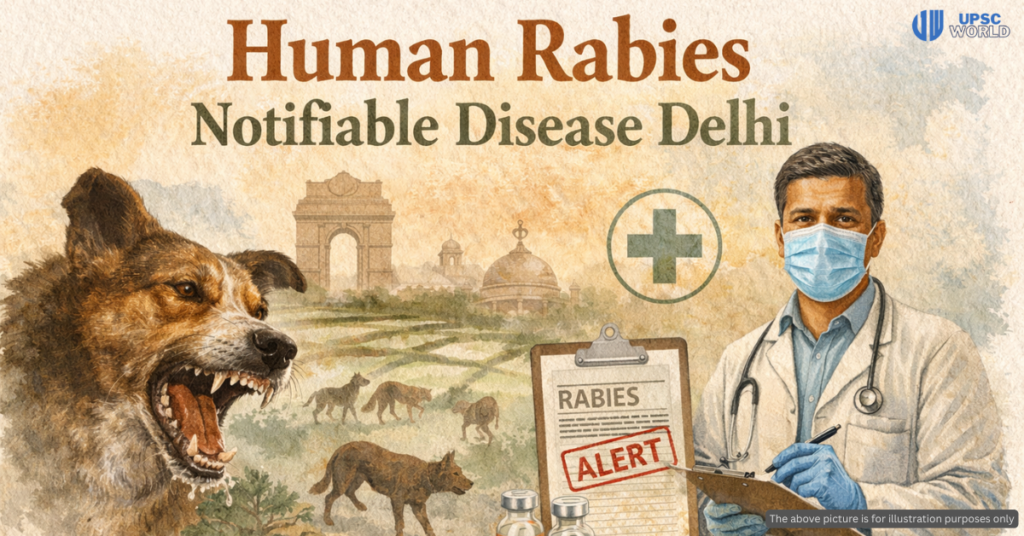
What is a Notifiable Disease?
- A notifiable disease is a disease that must be legally reported to public health authorities by medical practitioners and diagnostic laboratories when it is diagnosed or suspected.
- Mandatory notification enables real-time disease surveillance, which helps authorities detect outbreaks early and respond quickly.
- It allows governments to plan evidence-based public health interventions, including vaccination drives, awareness campaigns, and resource allocation.
- In India, State Governments and Union Territories decide which diseases are to be declared notifiable based on local epidemiological conditions.
- Common examples of notifiable diseases in India include cholera, tuberculosis, dengue, AIDS, measles, plague, meningitis, and hepatitis.
Legal and Institutional Framework Behind the Decision
Epidemic Diseases Act, 1897
- The Act was enacted during the colonial period to control the bubonic plague outbreak in the Bombay Presidency.
- Its primary objective is to ensure the effective prevention and control of dangerous epidemic diseases.
- Section 2 empowers State Governments and Union Territories to frame temporary regulations and take special measures during epidemics.
- Section 2A authorises the Central Government to regulate transport and detain individuals to prevent disease spread.
- Section 3 prescribes penalties for violating orders issued under the Act.
- Violence against healthcare personnel or damage to property can lead to imprisonment from three months to five years, along with fines.
- Section 4 provides legal protection to officials acting in good faith during epidemic control measures.
Institutional Support
- The Integrated Disease Surveillance Programme (IDSP) will play a key role in collecting data, monitoring trends, and enabling early intervention.
- At the international level, World Health Organization’s International Health Regulations require countries to report certain diseases for global surveillance and coordination.
Basics about Rabies
- Rabies is a vaccine-preventable, zoonotic viral disease that affects the central nervous system.
- It is caused by the rabies virus (RABV) and affects all mammals, including dogs, cats, livestock, and wildlife.
- Transmission occurs through saliva of infected animals, most commonly via:
- Bites and scratches
- Contact of saliva with open wounds or mucous membranes such as the eyes and mouth
- Rabies is classified as a Neglected Tropical Disease, as it disproportionately affects poor and vulnerable populations.
Health Risks and Disease Burden
- Rabies initially presents with fever, headache, and nausea, but later progresses to severe neurological symptoms.
- Advanced symptoms include hallucinations, agitation, hydrophobia (fear of water), paralysis, and coma.
- The disease is almost 100 percent fatal once clinical symptoms appear, making prevention critical.
- According to India’s National Rabies Control Programme, more than 6,600 suspected cases and deaths were reported between 2012 and 2022.
- The World Health Organization estimates that 18,000 to 20,000 rabies deaths occur annually in India, accounting for nearly 36 percent of global rabies deaths.
- Children between 5 and 14 years of age are the most vulnerable group, especially in endemic regions.
Prevention, Treatment, and Public Health Strategy
- Rabies is fully preventable with timely medical intervention.
- Post-Exposure Prophylaxis (PEP) includes:
- A four-dose anti-rabies vaccine schedule
- Rabies Immunoglobulin (RIG) for individuals who were not previously vaccinated
- WHO-approved vaccines such as RABIVAX-S, VaxiRab N, and VERORAB are used in India.
- Declaring rabies as a notifiable disease will:
- Improve early case detection
- Ensure timely administration of PEP
- Enable targeted dog vaccination and population control measures
- Reduce under-reporting of rabies-related deaths
Why Declaring Human Rabies Notifiable Matters?
- It strengthens public health surveillance by ensuring compulsory reporting of every suspected case.
- It creates accountability among healthcare providers and diagnostic laboratories.
- It enables data-driven policymaking, which is essential for eliminating a disease with high fatality but easy prevention.
- The move supports India’s commitments under global health initiatives and aligns with WHO’s rabies elimination goals.
- It is a critical step toward reducing preventable deaths in urban and peri-urban settings like Delhi.
— External source linked contextually from Business Standard; internal contextual reference to UPSCWorld for public health and governance topics.