
Why in the News?
- Battery Pack Aadhaar Number (BPAN) has been proposed by the Union Government to address growing concerns around electric vehicle battery traceability, recycling, and environmental safety.
- The proposal comes amid rapid expansion of India’s electric mobility ecosystem, where lithium-ion batteries dominate energy storage needs.
- Draft guidelines for implementing the BPAN system have been issued by the Ministry of Road Transport and Highways (MoRTH) to institutionalise a unified digital framework for battery management.
- The move aligns with India’s broader goals of sustainable mobility, circular economy, and Extended Producer Responsibility (EPR) enforcement.
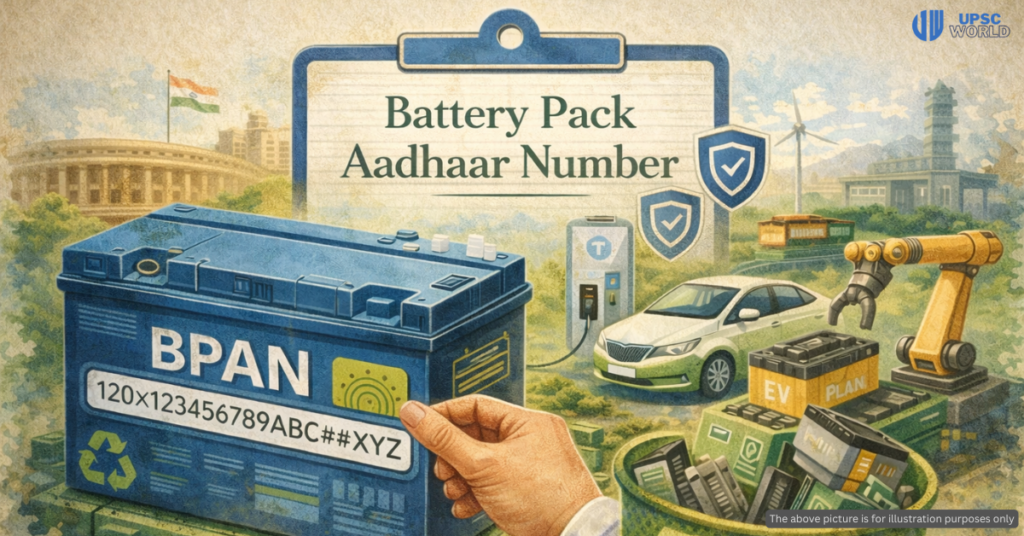
Basics about Battery Pack Aadhaar Number (BPAN)
- Battery Pack Aadhaar Number (BPAN) is a proposed 21-character unique identification number assigned to every battery pack introduced in the Indian market.
- It functions like a digital Aadhaar for batteries, enabling authorities to track each battery across its entire lifecycle.
- The system is designed primarily for electric vehicle batteries, which account for nearly 80–90 percent of India’s lithium-ion battery demand.
- BPAN aims to ensure that batteries are manufactured, used, repurposed, recycled, and disposed of in a transparent and accountable manner.
- The framework has been proposed under the Draft Guidelines for Implementation of the Battery Pack Aadhaar System, to be institutionalised through the Automotive Industry Standard (AIS) route under the Automotive Industry Standards Committee (AISC).
Key Features of the Battery Pack Aadhaar Number (BPAN)
- Mandatory Unique Identification
- Every battery producer or importer must assign a BPAN to each battery sold or used internally.
- The BPAN must be clearly visible and durably marked on the battery pack to prevent tampering or degradation.
- Comprehensive Lifecycle Data Capture
- The system records information from raw material sourcing and manufacturing to usage, performance monitoring, repurposing, recycling, and final disposal.
- Both static data (manufacturer details, battery specifications, material composition, carbon footprint) and dynamic data (battery health, charge-discharge cycles, thermal events) are captured.
- Digital Portal Integration
- Producers and importers are required to upload and update battery-related data on an official BPAN digital portal.
- Any significant structural, technical, or ownership change in the battery requires issuance of a new BPAN.
- Coverage and Prioritisation
- Electric vehicle batteries are given priority under the framework.
- Industrial batteries with a capacity above 2 kWh are also recommended to be covered in subsequent phases.
Significance for Environment and EV Ecosystem
- Efficient Recycling and Second-Life Use
- BPAN enables systematic identification of batteries suitable for repurposing in energy storage systems before final recycling.
- It supports a circular economy approach, reducing dependence on fresh raw materials.
- Environmental Protection
- By tracking batteries till end-of-life, the system reduces risks associated with improper disposal of lithium-ion batteries, such as soil and water contamination.
- It contributes to safer handling of hazardous battery components.
- Regulatory Compliance and Governance
- BPAN strengthens the enforcement of Extended Producer Responsibility (EPR) by clearly fixing accountability on manufacturers and importers.
- It enhances transparency and traceability in India’s fast-growing EV ecosystem.
- Support to Sustainable Mobility
- The system complements India’s clean energy transition and electric mobility push by ensuring that green technologies do not create hidden environmental costs.
External reference linked contextually from The Hindu; related environment and EV policy content can be explored on UPSCWorld.