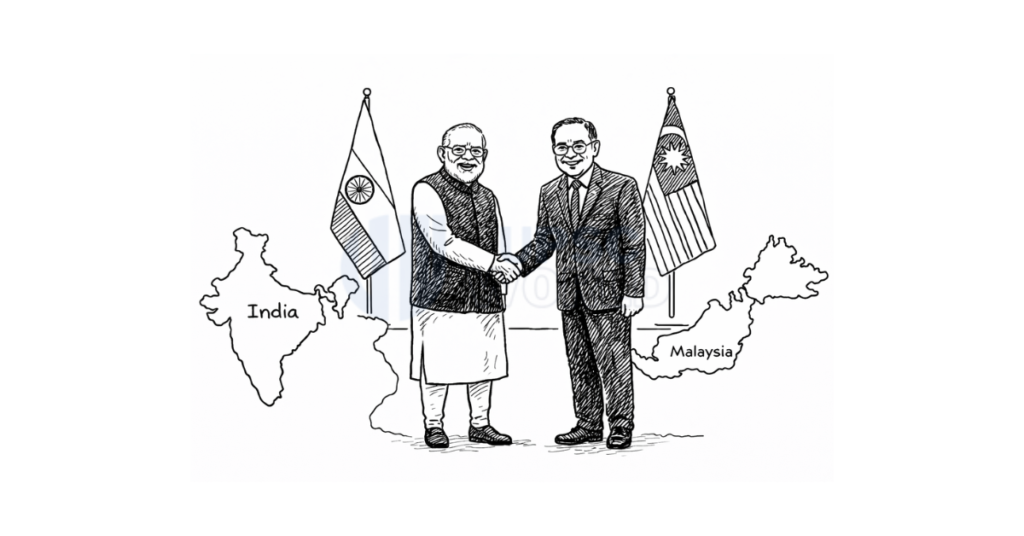
India and Malaysia signed 11 agreements and documents during Prime Minister Narendra Modi’s two-day visit to Kuala Lumpur.
It covers defence, security, digital payments, social security for Indian workers, semiconductors, disaster management, and peacekeeping.
The two Prime Ministers reiterated zero tolerance for terrorism, agreed to expand strategic trust, and committed to enhancing cooperation across the Indo-Pacific region.
Bilateral agreements and areas of cooperation
The two sides expanded cooperation intrade, investment, defence, energy, advanced manufacturing, and semiconductors, as stated during delegation-level talks.
A framework pact on semiconductors was included to deepen engagement in the sector.
Agreements were also signed in digital payments, audio-visual collaboration, tourism, disaster management, and peacekeeping operations.
Social security arrangements for Indian workers in Malaysia were part of the signed pacts.
The Prime Ministers jointly witnessed the sealing of 11 cooperation agreements and documents.
Trade, investment, and economic engagement
India and Malaysia agreed to promote trade settlement in local currencies, specifically the Indian rupee and Malaysian ringgit.
Local currency settlement allows bilateral trade to be conducted using domestic currencies instead of third-country currencies.
It aims toreduce transaction costs, foreign exchange risk, and dependence on external currencies.
Prime Minister Modi said India would “pave the way for economic transformation through strategic trust.”
Malaysia expressed support for India’s bid for permanent membership of a reformed United Nations Security Council (UNSC).
Malaysia and India agreed to work towards completing the review of the ASEAN–India Trade in Goods Agreement (AITIGA) expeditiously.
Malaysia indicated that bilateral trade could surpass the previous year’s level of $18.6 billion.
Prime Minister Anwar Ibrahim highlighted India’s significant rise in global trade and economic influence.
Security, defence, and counter-terrorism cooperation
Both leaders unequivocally and strongly condemned terrorism in all its forms and manifestations, including cross-border terrorism.
They reiterated a policy of “zero tolerance” for terrorism.
The joint statement committed the two countries to:
Counter radicalisation and violent extremism
Combat terror financing
Prevent the use of new and emerging technologies for terrorist purposes
Cooperation will be strengthened in counter-terrorism, intelligence sharing, maritime security, and defence production.
The two sides agreed to cooperate against transnational organised crime, including through information sharing, best practices, and capacity building.
The leaders reaffirmed cooperation in counter-terrorism at bilateral, multilateral, UN, and Financial Action Task Force (FATF) levels.
Indo-Pacific and ASEAN engagement
Prime Minister Modi stated that the Indo-Pacific region is emerging as the world’s growth engine.
India reiterated its commitment to development, peace, and stability in the Indo-Pacific, working closely with ASEAN.
India reaffirmed its support for ASEAN centrality in the regional architecture.
ASEAN centrality refers to the principle that ASEAN plays the primary role in shaping regional dialogue, cooperation, and institutions in Southeast Asia.
It ensures that regional frameworks remain inclusive and consensus-based, with ASEAN countries at the core of decision-making.
With support from countries like Malaysia, India said it would further expand relations with ASEAN nations.
Statements on terrorism and global stability
Prime Minister Modi reiterated India’s position: “On terrorism, our message is clear: no double standards, no compromise.”
Both leaders agreed that reform of global institutions is essential to address current global challenges.
The two sides committed to continued support for all efforts aimed at peace.