
Bharat Taxi cooperative cab service

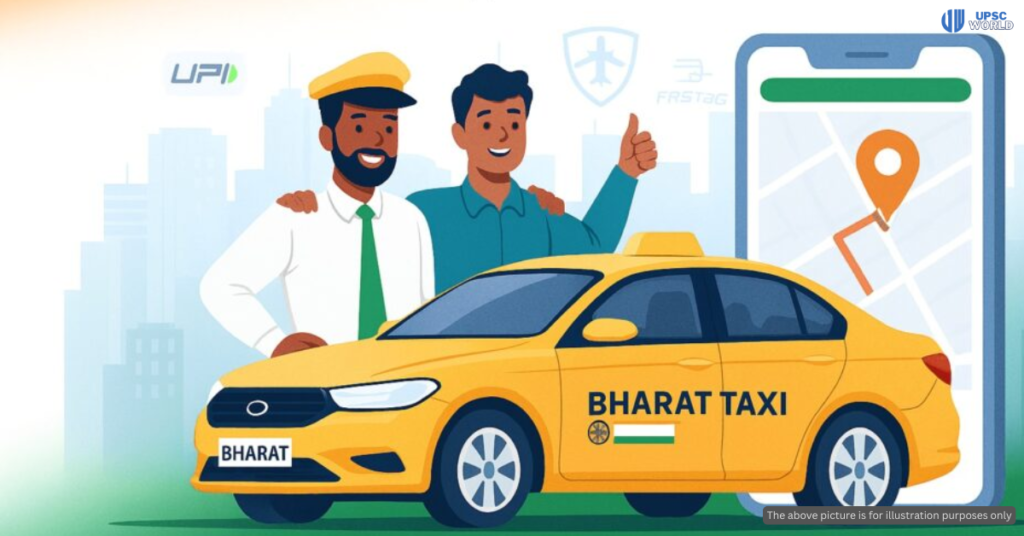
- The Union Minister for Home Affairs and Cooperation, Amit Shah, formally launched Bharat Taxi, a cooperative-based ride-hailing platform, in New Delhi.
- The initiative was introduced as a transformational reform in the urban mobility and transport services sector, with a focus on placing drivers, referred to as “sarathis,” at the centre of ownership and operations.
- The launch reflects the Government of India’s broader effort to promote cooperative models in emerging digital and platform-based economies.
What is Bharat Taxi?
- Bharat Taxi is a driver-owned, cooperative ride-hailing service, conceptualised under the vision of “Sahkar se Samriddhi” (Prosperity through Cooperation).
- Unlike private aggregator-based platforms, this model:
- Treats drivers as owners rather than gig workers, thereby reducing dependency on commission-heavy intermediaries.
- Aims to eliminate exploitative aggregator structures prevalent in app-based cab services.
- The initiative seeks to apply cooperative principles, traditionally used in agriculture and credit, to the digital mobility ecosystem.
Key features and provisions of Bharat Taxi
- Cooperative ownership structure
- Drivers, known as sarathis, are members and shareholders of the platform.
- Decision-making and revenue distribution are designed to remain driver-centric.
- Comprehensive social security coverage
- Each honoured sarathi receives:
- Personal accident insurance cover of ₹5 lakh.
- Family health insurance cover of ₹5 lakh.
- These provisions aim to address long-standing social security gaps in the gig economy.
- Each honoured sarathi receives:
- Driver welfare and dignity
- The model emphasizes long-term income security, professional dignity, and welfare of drivers.
- It seeks to stabilise earnings by reducing commission deductions.
- Institutional collaboration
- Memoranda of Understanding (MoUs) are being exchanged with:
- Key public sector institutions.
- Private stakeholders and technology partners.
- This collaboration supports platform scalability and technological robustness.
- Memoranda of Understanding (MoUs) are being exchanged with:
- Phased nationwide expansion
- Bharat Taxi is planned to expand across states and major cities over the next two years, enhancing accessibility and coverage.
Significance of Bharat Taxi
- Economic and labour significance
- The initiative represents a shift from platform capitalism to platform cooperativism, ensuring:
- Fair income distribution.
- Greater bargaining power for workers.
- It directly addresses concerns related to gig workers’ rights, an area of growing policy focus in India.
- The initiative represents a shift from platform capitalism to platform cooperativism, ensuring:
- Social significance
- By integrating insurance and welfare benefits, Bharat Taxi promotes:
- Social protection for informal and platform workers.
- Financial resilience for driver families.
- By integrating insurance and welfare benefits, Bharat Taxi promotes:
- Governance and institutional significance
- The platform aligns with the objectives of the Ministry of Cooperation, established in 2021 to strengthen cooperative institutions.
- It sets a precedent for cooperative-based digital public service delivery.
Challenges and concerns
- Technological competitiveness with established private aggregators may pose adoption challenges.
- Ensuring efficient governance and transparency within large cooperative structures requires robust institutional mechanisms.
- Sustaining financial viability while keeping user fares competitive remains a critical concern.
Way forward
- Strengthening digital infrastructure and user experience to compete with private platforms.
- Integrating Bharat Taxi with urban transport policies and smart city initiatives.
- Expanding welfare coverage through convergence with social security codes and state-level schemes.
- Continuous capacity building of sarathis in digital literacy and service quality.






Responses