
Bulgaria in Eurozone

Why in the News?
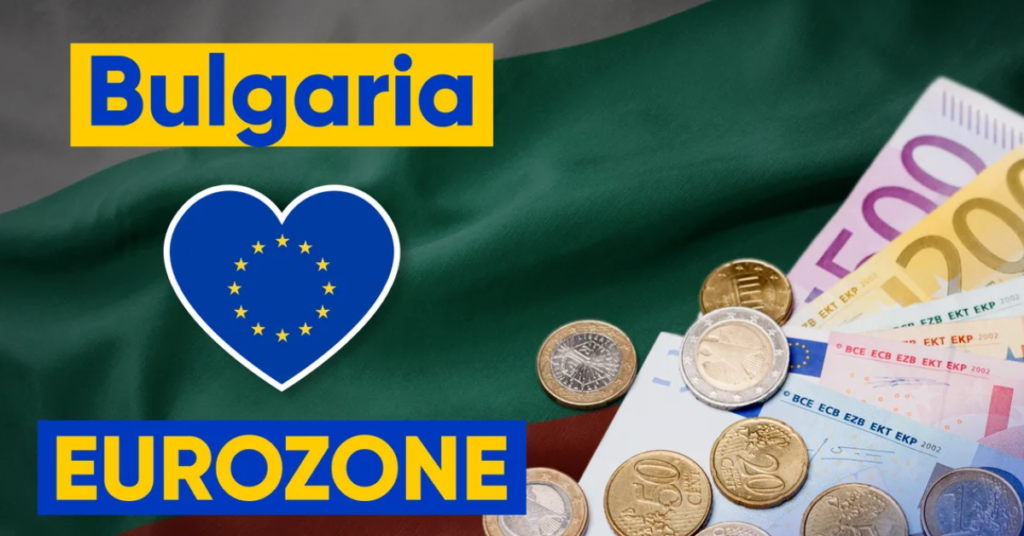
- Bulgaria officially adopted the euro recently, replacing its national currency, the Bulgarian lev, and becoming the 21st member of the eurozone.
- The move came nearly two decades after Bulgaria joined the European Union in 2007, marking a significant step toward deeper European economic and monetary integration.
- With this transition, Bulgaria gained representation in the European Central Bank’s monetary decision-making, aligning its economy with the euro area’s unified monetary framework.
What is the Eurozone?
- The eurozone, also known as the euro area, is the group of European Union countries that have adopted the euro as their sole legal tender and follow a common monetary policy.
- It represents the monetary arm of the Economic and Monetary Union (EMU) and aims to ensure price stability, economic convergence, and seamless financial integration.
- With Bulgaria’s entry, 21 out of 27 EU member states now use the euro, while the remaining six retain their national currencies.
- Some non-EU microstates such as Andorra, Monaco, San Marino, and the Vatican City use the euro through formal agreements, while Kosovo and Montenegro use it unilaterally, though none are eurozone members.
Evolution and Institutional Framework of the Eurozone
- The Maastricht Treaty of 1992 formally established the European Union and laid the legal foundation for the Economic and Monetary Union.
- The euro was introduced for electronic and accounting purposes in 1999, while physical notes and coins entered circulation in 2002, replacing national currencies in participating states.
- Monetary policy in the eurozone is conducted by the Eurosystem, which includes the European Central Bank (ECB) and national central banks of euro-area countries.
- The ECB’s Governing Council sets a single monetary policy with a primary mandate of maintaining price stability across the eurozone.
- Fiscal coordination is supported by institutions such as:
- The Eurogroup, an informal forum of eurozone finance ministers.
- The European Stability Mechanism (ESM), established in 2012 to provide financial assistance to eurozone countries facing severe economic distress.
Eligibility and Benefits of Eurozone Membership
- Eurozone entry requires compliance with the Maastricht convergence criteria, which ensure macroeconomic stability and alignment with existing members:
- Inflation levels must remain close to the best-performing EU countries.
- Fiscal discipline must be maintained with government deficits below 3 percent of GDP.
- Public debt should remain below 60 percent of GDP or show a sustainable downward trend.
- Exchange-rate stability must be demonstrated through participation in the ERM II mechanism.
- Benefits of adopting the euro include:
- Enhanced price stability and lower interest rates due to credible monetary policy.
- Elimination of currency exchange costs, facilitating trade, tourism, and investment.
- Easier price comparison across member states, benefiting consumers and businesses.
- Greater resilience to external economic shocks due to the eurozone’s collective economic size.
- Stronger political and economic integration, as the euro is the world’s second-largest reserve currency.
Key Facts about Bulgaria
- Bulgaria is a Balkan country located in southeastern Europe, occupying the eastern part of the Balkan Peninsula and acting as a strategic link between Europe, the Black Sea region, and West Asia.
- It is bordered by Romania to the north, Serbia and North Macedonia to the west, Greece and Turkey to the south, and the Black Sea to the east, giving it both continental and maritime significance.
- Sofia, the capital city, lies in a mountainous basin in western Bulgaria and serves as the political, economic, and cultural hub of the country.
- Physiographic features of Bulgaria shape its economy and connectivity:
- The Danubian Plain in the north forms a fertile agricultural belt.
- The Balkan Mountains run east–west across the country.
- The Rila–Rhodope Massif in the south contains Mount Musala, the highest peak in the Balkans.
- The Black Sea coastline supports ports, tourism, and regional trade.
- Bulgaria has been a member of NATO since 2004, strengthening its political and security integration with the Euro-Atlantic bloc.




Responses