
India Seafood Export Growth

Why in the News?
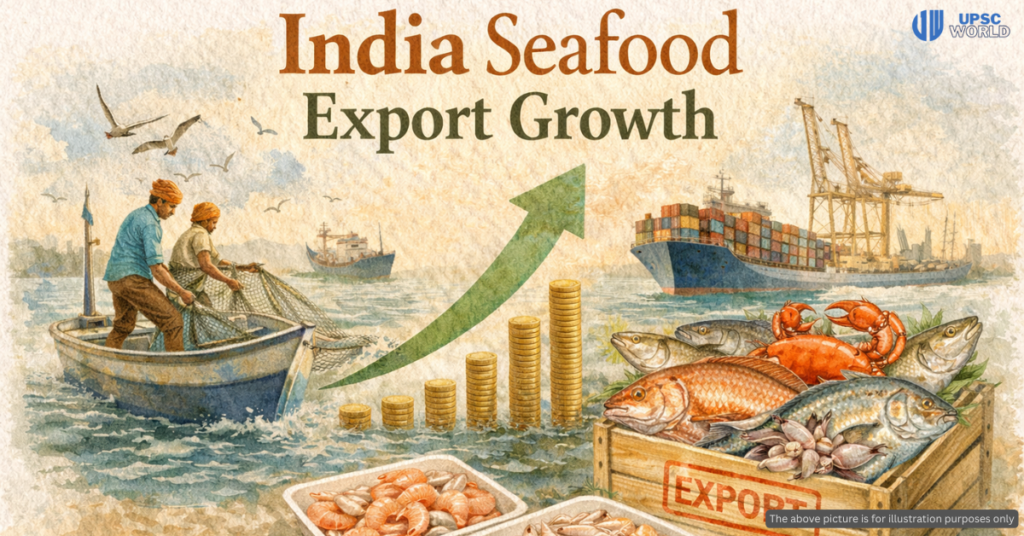
- India Seafood Export Growth has drawn attention after official data showed a sharp rise in marine product exports during the first seven months of FY 2025–26.
- India’s seafood exports increased by 16 percent in value and 12 percent in volume between April and October 2025 compared to the same period in the previous financial year.
- The growth occurred despite higher tariffs imposed by the United States, indicating improved resilience and diversification of India’s export strategy.
- Policymakers and export bodies have described this performance as a sign of structural strength and adaptability in India’s fisheries sector.
Background → India’s Seafood Sector
- India has one of the largest and most diverse seafood sectors in the world, supported by:
- A coastline of over 7,500 kilometres
- Extensive inland water resources such as rivers, reservoirs, ponds, and wetlands
- India is the third-largest fish producer globally and the second-largest producer of aquaculture products.
- The sector plays a vital role in:
- Employment generation, especially in coastal and rural areas
- Foreign exchange earnings
- Nutritional security, by providing affordable animal protein
- Over the past decade, India has seen a shift from capture fisheries to culture fisheries, with aquaculture emerging as the backbone of export growth.
Scale and Market Trends of India Seafood Export Growth
- India’s seafood export earnings rose from $4.19 billion to $4.87 billion during April–October 2025.
- Export volumes increased from 9.62 lakh metric tonnes to 10.73 lakh metric tonnes in the same period.
- Shrimp, particularly frozen varieties such as Vannamei, continues to dominate export value and volume.
- Other major export products include:
- Frozen fish
- Cuttlefish and squid
- Crabs and other value-added marine products
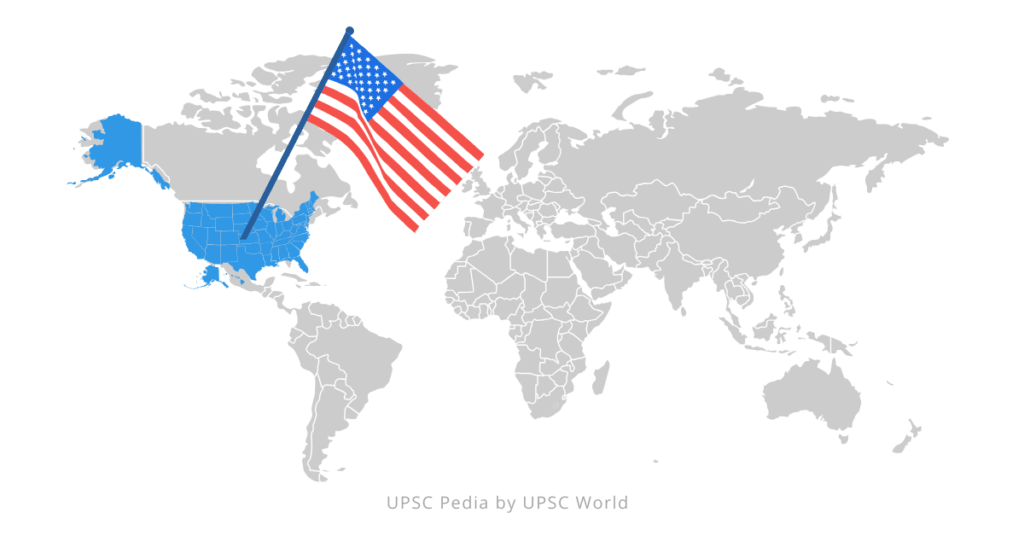
- Although exports to the United States declined slightly, it remains India’s largest single export destination.
Drivers Behind India Seafood Export Growth
- Rising Global Demand
- Global consumers are increasingly preferring protein-rich and low-fat diets, boosting seafood demand.
- Strong demand persists in the United States, European Union, Japan, China, and Southeast Asia.
- Market Diversification Strategy
- Exporters have reduced dependence on a single market by expanding into China, Vietnam, Belgium, Malaysia, and Germany.
- Vietnam recorded over 100 percent growth in export value, while Belgium saw nearly 90 percent growth, reflecting successful diversification.
- This eastward and European pivot has reduced vulnerability to tariff shocks.
- Government Policy and Institutional Support
- The Pradhan Mantri Matsya Sampada Yojana (PMMSY) has strengthened fisheries infrastructure through:
- Modern fishing harbours
- Cold-chain logistics
- Processing and storage facilities
- The Marine Products Export Development Authority (MPEDA) supports exporters through quality control, traceability systems, and market access initiatives.
- The Pradhan Mantri Matsya Sampada Yojana (PMMSY) has strengthened fisheries infrastructure through:
- Improved Quality and Compliance
- Indian exporters have increasingly complied with international food safety standards.
- Enhanced traceability systems have helped meet sanitary and phytosanitary norms of importing countries.
- Expansion of Aquaculture
- Shrimp farming, especially in coastal states, has expanded rapidly.
- This shift has reduced pressure on marine ecosystems while ensuring stable export supplies.
Economic Importance and Blue Economy Linkages
- Seafood exports contribute significantly to foreign exchange earnings, helping improve India’s trade balance.
- The fisheries sector supports millions of livelihoods, making it second only to agriculture in employment generation.
- Fisheries are central to India’s Blue Economy vision, which seeks to balance:
- Economic growth
- Environmental sustainability
- Livelihood security
- The sector also strengthens food and nutritional security, particularly in low-income regions.
Challenges and the Way Forward
- A relatively small share of seafood undergoes value addition, limiting export profitability.
- High tariffs in the United States and stringent quality norms in Europe remain barriers.
- Overfishing, habitat degradation, and climate change threaten long-term sustainability.
- Gaps persist in cold-chain infrastructure, logistics, and modern processing capacity.
- Going forward, India’s seafood sector must focus on:
- Greater value addition
- Eco-friendly aquaculture
- Continued market diversification
- .Stronger infrastructure and policy coordination
→ External source linked contextually from The Indian Express; related governance and economy content can be explored on UPSCWorld.



Responses