
India’s oil imports from Russia hit 38-month low

Why in the news?
- India’s crude oil imports from Russia declined to a 38-month low in December 2025, with Russia’s share in India’s oil basket falling sharply.
- Official data showed a reduction in both the value and volume of Russian oil imports during the month.
Fall in Russian oil imports
- The value of India’s crude oil imports from Russia declined to $2.7 billion in December 2025, the lowest level in 38 months.
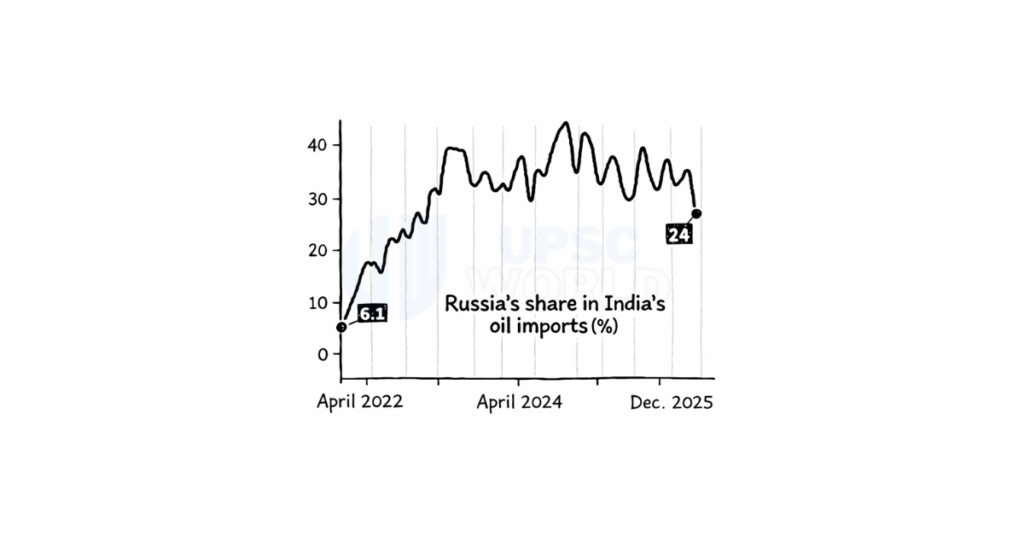
- Russia’s share in India’s crude oil imports fell to about 25% in December 2025, down from 34% in November 2025.
- In volume terms, India imported 5.8 million tonnes of oil from Russia in December 2025, the lowest since February 2025.
- Imports from Russia in December 2025 were 15% lower than December 2024 and 27.1% lower than November 2025.
- Russian oil accounted for less than a quarter of India’s crude oil imports during the month.
Trends over recent months
- Data showed that India’s imports of Russian oil had remained elevated through much of 2023 and 2024, before declining sharply by December 2025.
- A chart published with the data indicated that Russia’s share in India’s oil imports peaked above 35% in earlier months before falling to 24.9% in December 2025.
- The fall marked the lowest Russian share in three years.
Imports from the United States
- India imported $569.3 million worth of oil from the U.S. in December 2025.
- This was 60.5% lower than November 2025, when imports from the U.S. had surged to a seven-month high.
- Despite the month-on-month decline, oil imports from the U.S. were nearly 31% higher than December 2024.
- In volume terms, India imported 1.1 million tonnes of oil from the U.S. in December 2025, which was 58% higher than December 2024.
Diversification of oil sources
- Crude oil import diversification refers to sourcing oil from multiple countries instead of relying heavily on one supplier.
- It is done to manage supply risks, price volatility, and logistical constraints.
- Countries often adjust sourcing based on prices, freight costs, quality of crude, and geopolitical conditions.
- India sourced crude oil from 19 countries in December 2025, up from 16 countries in December 2024.
- Among these 19 countries, 10 countries saw their share in India’s crude oil basket increase, while Russia’s share declined.
- The data indicated a broader diversification of oil imports during the month.
Statements and official position
- U.S. President Donald Trump claimed that India would stop importing Russian oil in exchange for lower U.S. tariffs on Indian imports, with tariff levels mentioned as falling from 50% to 18%.
- India neither confirmed nor denied this claim.
- Indian officials stated that India is diversifying its energy sources while keeping in mind objective market conditions and evolving international dynamics.
Cost and freight comparisons
- A senior government official stated that the U.S. Gulf Coast is about 4.5 to five times farther from India than Russia in shipping distance.
- The distance from Venezuela to India was stated to be similar to that from the U.S.
- Officials said India receives discounted Russian oil at present.
- Lower shipping distances were cited as making Russian oil cheaper to import compared to oil from the U.S. or Venezuela.
- According to estimates cited, oil shipped from Venezuela or the U.S. Gulf Coast could cost as high as $4.5 per barrel in shipping, compared to a maximum of $1 per barrel from West Asia.
- It was noted that estimating transport costs is difficult because companies negotiate separate deals with non-sanctioned entities in Russia.
Prices paid for crude oil
- Indian companies paid an average of $506.7 per tonne for oil imported from the U.S. in December 2025.
- The average price paid for Russian oil in the same month was $469.4 per tonne.
- India did not import Venezuelan oil in December 2025.
Assessment on replacing Russian oil
- An internal analysis by the State Bank of India stated that India could entirely switch away from Russian oil and replace it with Venezuelan oil.
- The analysis said such a switch would be commercially viable if Venezuelan crude were available at a discount of $10 to $12 per barrel due to its sourness.






Responses