
Tropics

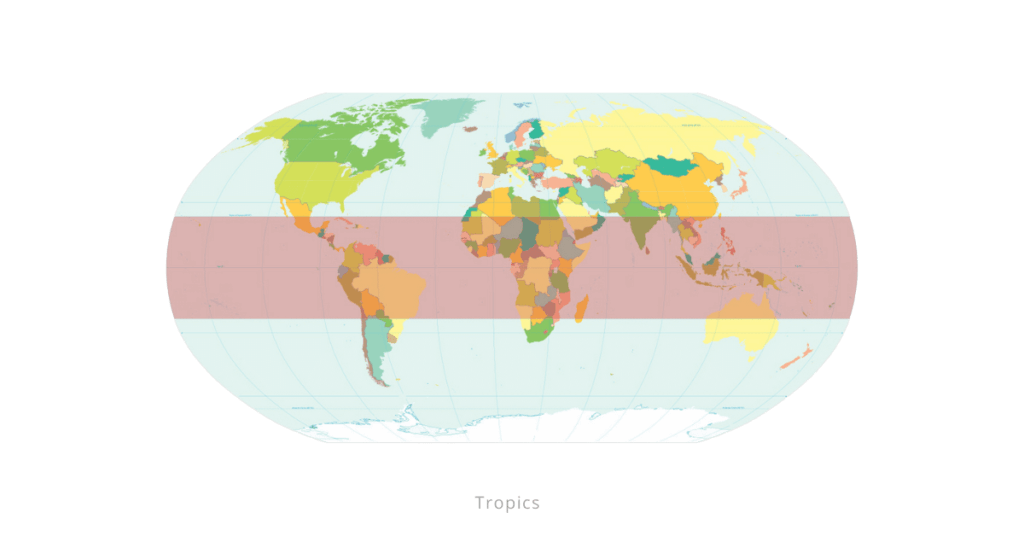
- The Tropics are regions near the Earth’s equator, characterized by warm temperatures, high humidity, and abundant sunshine throughout the year.
- According to National Oceanic and Atmospheric Administration, The Tropics are defined as the region between the Tropic of Cancer (23.5°N) and the Tropic of Capricorn (23.5°S), encompassing the area around the Earth’s equator.
- The names “Cancer” and “Capricorn” were attributed about 2,000 years ago based on the position of the Sun in the summer solitude zodiac.
- These positions are no longer valid because the exact location of the tropics varies on geologic time scales with the inclination of the Earth on its orbit.
- The Tropics have a tropical climate, with average temperatures above 18°C (64°F) and high levels of precipitation, leading to lush vegetation and diverse ecosystems.
- The Tropics include regions such as the Amazon rainforest, Southeast Asia, Africa, and the Pacific Islands, each with unique cultural, geological, and biological characteristics.
- The Tropics are important for global agriculture, with many crops like coffee, chocolate, and bananas being grown in these regions.
- The Tropics are home to a vast array of flora and fauna, with many species found nowhere else on Earth.
Interesting Facts about Tropics
- The Tropics receive direct sunlight throughout the year, leading to high levels of solar radiation.
- The Amazon rainforest, located in the Tropics, produces about 20% of the world’s oxygen.
- The Tropics are home to over half of the world’s population.
Latest News
- July 5, 2024:
- “Tropical forests regrowing in Africa could help combat climate change”
- A new study suggests that regrowing tropical forests in Africa could remove significant amounts of carbon dioxide from the atmosphere, contributing to global efforts to combat climate change. (Source: BBC News)
Responses