
United States

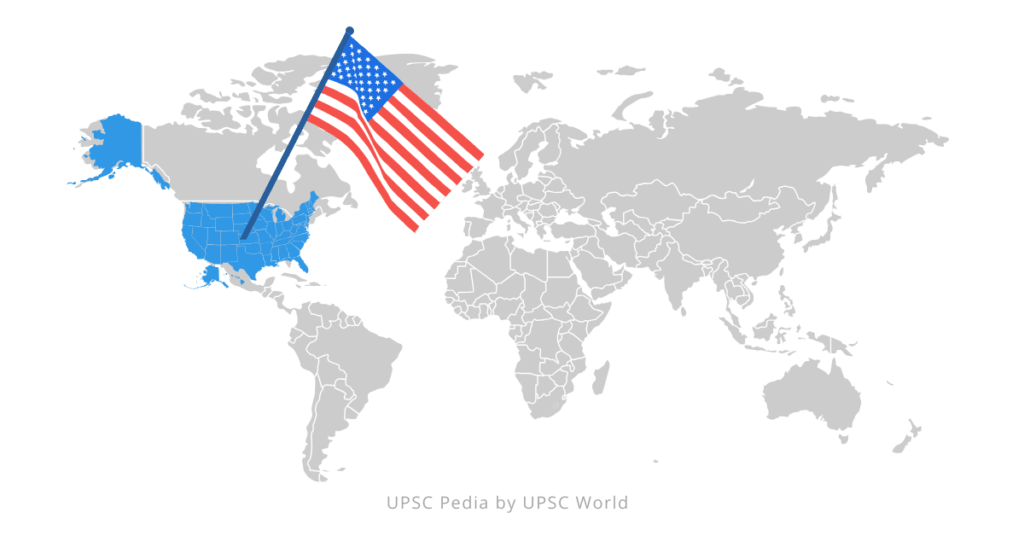
- The United States of America (USA) or the United States ( U.S.) is a country located in North America.
- The capital is Washington, D.C.
Geography of united states
- The United States is the fourth largest country in the world (after Russia, Canada, and China).
- It extends across North America from the Atlantic Ocean on the east to the Pacific Ocean on the west.
- The United States is made up of 50 states and the District of Columbia.
- Forty-eight of the states lie between Canada on the north and Mexico and the Gulf of Mexico on the south.
- The 49th state, Alaska, lies northwest of Canada.
- The 50th state, Hawaii, is a group of islands in the Pacific Ocean.
- The landscape of the United States ranges from rugged mountains to flat prairies and from moist rain forests to dry deserts.
- The mountain ranges include the Rocky Mountains and the Sierra Nevada in the west and the Appalachian Mountains in the east.
- Between the Appalachians and the Rocky Mountains is a vast lowland region that includes the Great Plains.
- The highest point in the country is Mount McKinley, in Alaska.
- The lowest point is Death Valley, in the California desert.
- The United States has some of the largest and most useful rivers and lakes in the world.
- The longest rivers are the Mississippi and Missouri.
- The climate of the United States is as varied as its land. It ranges from Arctic cold in Alaska to tropical warmth in Hawaii and southern Florida.
Plants and Animals
- Forests in the eastern United States have pine, hemlock, oak, hickory, birch, and maple trees.
- Pine, fir, and spruce forests are common in the Rocky Mountains and along the Pacific coast.
- Grasslands cover large parts of the central plains.
- Sagebrush, yucca, and cactus are common in the deserts of the Southwest.
- The animals of the forest include bears, elk, deer, foxes, bobcats, beavers, opossums, and raccoons.
- Coyotes, prairie dogs, jackrabbits, and a few bison (buffalo) live on the grasslands.
- Desert animals include snakes, lizards, scorpions, and roadrunners.
People
- The United States is made up of people from many backgrounds.
Race
- Whites make up more than 70 percent of the population. They have roots in Great Britain, Ireland, Germany, Italy, Poland, Russia, Sweden, and other European countries.
- The two largest minority groups are African Americans and Hispanic Americans.
- Asian Americans, Pacific Islanders, and Native Americans make up small groups.
Language
- Most Americans speak English.
- The country also has many Spanish speakers because of its large Hispanic population.
Religion
- More than four fifths of the population is Christian.
- Protestants are the largest Christian group, followed by Roman Catholics.
- Other people practice Islam, Judaism, Buddhism, and Hinduism.
Economy
- The United States is a great economic power.
- Service industries make up the largest part of the economy.
- They include finance, health care, education, and tourism.
- Major manufactured products include iron and steel, chemicals, electronics, motor vehicles, aircraft, and food.
- The United States is rich in resources.
- Its farmlands produce corn, soybeans, wheat, cotton, and many other crops that are sold to countries all over the world.
- The United States is among the world’s leading producers of several minerals, including copper, silver, zinc, gold, coal, petroleum (oil), and natural gas.
- Forestry and fishing are important industries, too.
History
- The first people to live in the Americas were the Native Americans.
- By the 1400s there were about 200 different groups of Native Americans living on the land that became the United States.
- The history of the Americas changed forever in 1492 when Christopher Columbus sailed there from Spain.
- After Columbus’ voyage, many other explorers and settlers came from Europe.
Colonies
- The first lasting European settlement in what is now the United States was Saint Augustine, Florida.
- It was built by the Spanish in 1565.
- The Spanish made Florida and what is now the southwestern United States into colonies.
- The English, the French, and the Dutch (people from the Netherlands) also set up colonies.
- The English founded their first lasting settlement in North America in 1607.
- It was Jamestown, in what was later the state of Virginia.
- Then the English built other settlements and seized colonies from the Dutch.
- Soon there were 13 English colonies along the Atlantic coast.
- In 1700, about 250,000 people lived in the 13 colonies.
- By 1760, the population was nearly 1.7 million. Many of the newcomers were Africans who were brought to work as slaves, especially in the South.
American Revolution
- In the 1760s, the British government started to tighten its control over the colonies.
- Parliament, the British legislature, forced the colonists to pay new taxes.
- The colonists protested. Tension built up between Britain and the colonies.
- In 1775, fighting broke out between colonists and British forces in Concord and Lexington, Massachusetts.
- These battles began the American Revolution.
- On July 4, 1776, the colonies approved the Declaration of Independence.
- This document made the colonies into the United States.
- The American Revolution continued until the British surrendered in 1781.
- By signing a treaty in 1783, Britain accepted the independence of the United States.
Birth of the New Country
- In 1787, representatives from the states met in Philadelphia, Pennsylvania.
- The meeting produced a document that outlined a new government.
- The document was the U.S. Constitution. It took effect in 1789.
- George Washington became the country’s first president.
- In 1803, President Thomas Jefferson bought the Louisiana Territory from France.
- The purchase added a vast area west of the Mississippi River to the United States.
- In 1819, the United States acquired Florida from Spain.
- Texas became a state in 1845.
- The United States and Mexico disagreed over the border between Texas and Mexico.
- In 1846, the countries went to war.
- The Mexican War lasted until 1848.
- The United States defeated Mexico and took over California and the rest of the Southwest.
- The United States bought Alaska in 1867 and claimed Hawaii in 1898.
- Also in 1898, the United States defeated Spain in the Spanish-American War.
- The United States took over Spain’s colonies of Puerto Rico, Guam, and the Philippines.
- The United States was then a world power.
Civil War and Reconstruction
- In the middle of the 1800s slavery divided the United States.
- Southern farms depended on slave labor, but many Northerners were strongly against slavery.
- In 1860, Abraham Lincoln was elected president.
- His party, the Republicans, opposed slavery.
- After Lincoln’s election, the Southern states began to secede (withdraw) from the United States.
- They formed their own government. It was called the Confederate States of America, or the Confederacy.
- In 1861, war broke out between the U.S. government (called the Union) and the Confederacy.
- This was the American Civil War.
- The Confederacy won most of the early battles, but by 1864 the Union was winning.
- In 1865, the Confederate general Robert E. Lee surrendered.
- The period after the Civil War is known as Reconstruction.
- The Republican leaders of Congress passed harsh laws to punish the South.
- These laws angered many Southern whites.
- And even though the war had ended slavery, African Americans still struggled.
- Many became poor farmworkers.
World Wars and the Depression
- In 1914, World War I broke out in Europe. The United States entered the war in 1917.
- The American side, called the Allies, won the war in 1918.
- During the 1920s the United States enjoyed peace and economic good times.
- But in 1929, a “crash” in the stock market started a serious economic downturn called the Great Depression.
- Many people lost their jobs and their savings.
- In the 1930s, President Franklin D. Roosevelt started programs that helped businesses and farmers and gave people jobs.
- The programs were called the New Deal.
- By 1940 the United States was coming out of the Depression.
- The next big challenge was World War II, which began in 1939 in Europe.
- The countries of Germany, Italy, and Japan were called the Axis powers.
- The other side included Britain, France, and the Soviet Union. They were called the Allies.
- On December 7, 1941, Japanese planes bombed a U.S. naval base at Pearl Harbor, Hawaii.
- Then the United States entered the war on the side of the Allies.
- U.S. forces fought in Europe and North Africa and on islands in the Pacific Ocean.
- The war in Europe ended in May 1945, when Germany surrendered.
- The war in the Pacific ended in August 1945, after the United States dropped nuclear bombs on the Japanese cities of Hiroshima and Nagasaki.
Civil Rights
- In the 1950s and 1960s African Americans struggled to gain better treatment.
- Their efforts became known as the civil rights movement.
- A minister named Martin Luther King, Jr., led nonviolent protests against segregation, or separation.
- The Civil Rights Act of 1964 finally guaranteed many rights to African Americans.
The Cold War
- After World War II, the United States became involved in a tense rivalry with the Soviet Union.
- This rivalry became known as the Cold War.
- The first major conflict over Communism was the Korean War.
- The Vietnam War was another fight over Communism.
- Starting in the 1950s Communist rebels tried to overthrow the government of South Vietnam.
- The United States helped South Vietnam.
- Many people protested against the war. U.S. troops gradually left Vietnam in the early 1970s.
- In 1991 the Soviet Union broke up, ending the Cold War.
Terrorist attacks
- In the early 21st century the United States worried more about threats from terrorists than from other countries.
- In 2001 members of a terrorist group called al-Qaeda hijacked (seized) four airplanes and crashed three into buildings.
- The attacks killed nearly 3,000 people.
- After the attacks President George W. Bush announced a “war on terror.”
- The United States attacked Afghanistan in 2001 and Iraq in 2003.
- Bush accused the leaders of both countries of supporting terrorism.
- In 2008 the United States elected its first African American president, Barack Obama.

Responses