
US Strike on Venezuela 2026

Why in the News?
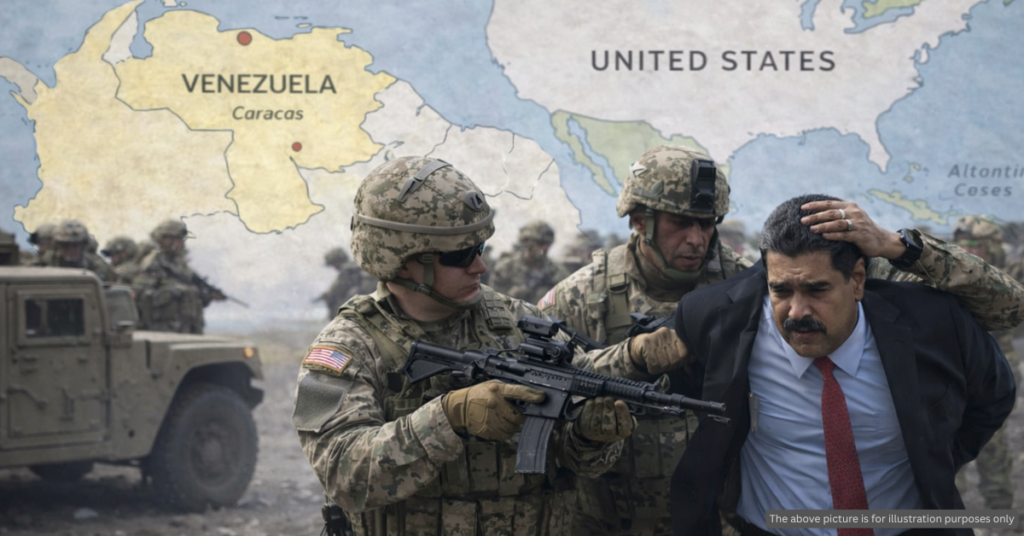
- The US Strike on Venezuela 2026 drew global attention after the United States carried out military operations in and around Caracas, leading to the capture of Venezuelan President Nicolás Maduro.
- The United States described the action as necessary to address narco-terrorism, illegal migration, and regional instability, while also invoking the Monroe Doctrine as a strategic justification.
- The operation triggered widespread debate on violation of national sovereignty, breach of international law, and the revival of US interventionism in Latin America.
- Major global actors responded cautiously, reflecting concerns about the erosion of the rules-based international order.
Why Did the United States Strike Venezuela?
Energy and Resource Considerations
- Venezuela’s vast oil reserves make it a strategic energy asset, especially at a time when global geopolitics increasingly revolves around resource security.
- The United States announced plans to allow American oil companies to repair Venezuela’s damaged infrastructure, extract crude, and sell it internationally.
- Analysts note that while immediate global oil price shocks are unlikely, long-term supply expansion could influence global markets if production is successfully revived.
Countering China’s Influence
- China has emerged as the largest buyer of Venezuelan crude, integrating Venezuela into its broader energy security strategy.
- For the United States, Venezuela represents a geopolitically sensitive node in the competition to limit China’s influence in the Western Hemisphere.
Narco-Terrorism and Migration Narrative
- Washington accused the Maduro regime of facilitating drug trafficking networks, designating groups such as Tren de Aragua as terrorist organisations.
- The United States also linked Venezuela’s instability to rising migration flows towards its southern border, a claim rejected by Caracas as politically motivated.
Monroe Doctrine and Its Contemporary Revival
- The Monroe Doctrine, proclaimed in 1823 by President James Monroe, asserted that the Western Hemisphere lay within the exclusive sphere of influence of the United States.
- It opposed new European colonisation and external intervention in the Americas while promising US non-interference in European affairs.
- From Doctrine to Intervention
- The Roosevelt Corollary (1904) expanded the doctrine by asserting the US right to intervene in Latin American countries to prevent instability or European involvement.
- Over time, the doctrine became a justification for repeated US interventions across Latin America.
- Application in Venezuela
- In 2026, the United States described its actions in Venezuela as a modern reinterpretation of the Monroe Doctrine, arguing that instability and the presence of rival powers warranted intervention.
- Critics argue that this represents neo-imperialism, undermining sovereignty and reviving a doctrine historically associated with coercive diplomacy.
Global Reactions and International Law Concerns
- Russia condemned the US action as an act of armed aggression.
- The European Union called for restraint and adherence to the United Nations Charter, particularly Article 2, which restricts the use of force.
- Several Latin American leaders expressed concern that unilateral military action could destabilise the region further.
- Comparisons were drawn with the 2003 Iraq invasion, highlighting risks of prolonged instability following regime-change interventions.
Key Facts about Venezuela and Its Strategic Importance
- Venezuela is a federal multiparty republic located on the northern coast of South America, with coastlines along the Caribbean Sea and the Atlantic Ocean.
- It possesses the world’s largest proven crude oil reserves, estimated at over 300 billion barrels, making it one of the most resource-rich countries globally.
- Despite this, Venezuela contributes less than 1 percent of global oil production, largely due to US sanctions, infrastructure decay, and prolonged underinvestment.
- Since 1999, Venezuela has followed a socialist political model, initiated by Hugo Chávez and continued by Nicolás Maduro, marked by extensive state control over the oil sector.
- Economic collapse, hyperinflation, and political repression since 2013 have resulted in a massive humanitarian and migration crisis, with nearly eight million Venezuelans leaving the country.
Impact on India: Limited Exposure, Significant Principles
- Energy and Trade Linkages
- India imported USD 255.3 million worth of crude oil from Venezuela in 2025, accounting for only 0.3 percent of its total oil imports.
- Since 2019, India has sharply reduced energy and commercial engagement with Venezuela due to US sanctions.
- Bilateral trade has steadily declined, with India’s exports dominated by pharmaceutical products.
- Diplomatic Considerations
- India traditionally upholds sovereignty, non-intervention, and multilateralism, values that are central to its foreign policy identity.
- At the same time, India is engaged in sensitive trade and strategic negotiations with the United States, requiring diplomatic balance.
- Given minimal on-ground stakes, the situation is unlikely to affect India’s economy, but it carries high normative significance.
Way Ahead
- The US Strike on Venezuela 2026 reflects a broader trend of resource-driven geopolitics in a fragmented global order.
- If sanctions are eased in the future, Venezuelan crude could help India diversify its energy basket and reduce supply concentration risks.
- India must continue to protect its strategic autonomy, support international law, and secure energy access without compromising long-term interests.
- The episode highlights the weakening of global consensus on sovereignty and multilateral conflict resolution.
External reference: The Hindu

Responses